
ENTERPRISE CONTENT SERVICES PLATFORM
Enterprise content management (ECM) software helps organizations take control of their documents, data, and workflows without the chaos of disconnected systems. Modern businesses generate massive volumes of content every day, from contracts and invoices to customer records and compliance documents. Without a centralized solution, managing this information becomes inefficient, risky, and expensive.
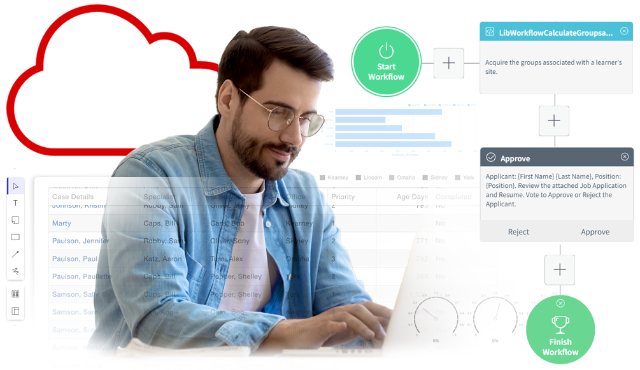
A cloud-based content services platform can integrate with multiple existing systems and bring everything together into one functional environment. It enables full document lifecycle management, from capture and storage to workflow automation and secure retrieval—while supporting enterprise workflows across departments.
With intelligent automation, seamless integrations, and secure cloud access, organizations can streamline operations, improve compliance, and empower teams to access the information they need anytime, anywhere. The organizational and process-oriented benefits of enterprise content management software provides the foundation for smarter, faster business processes.
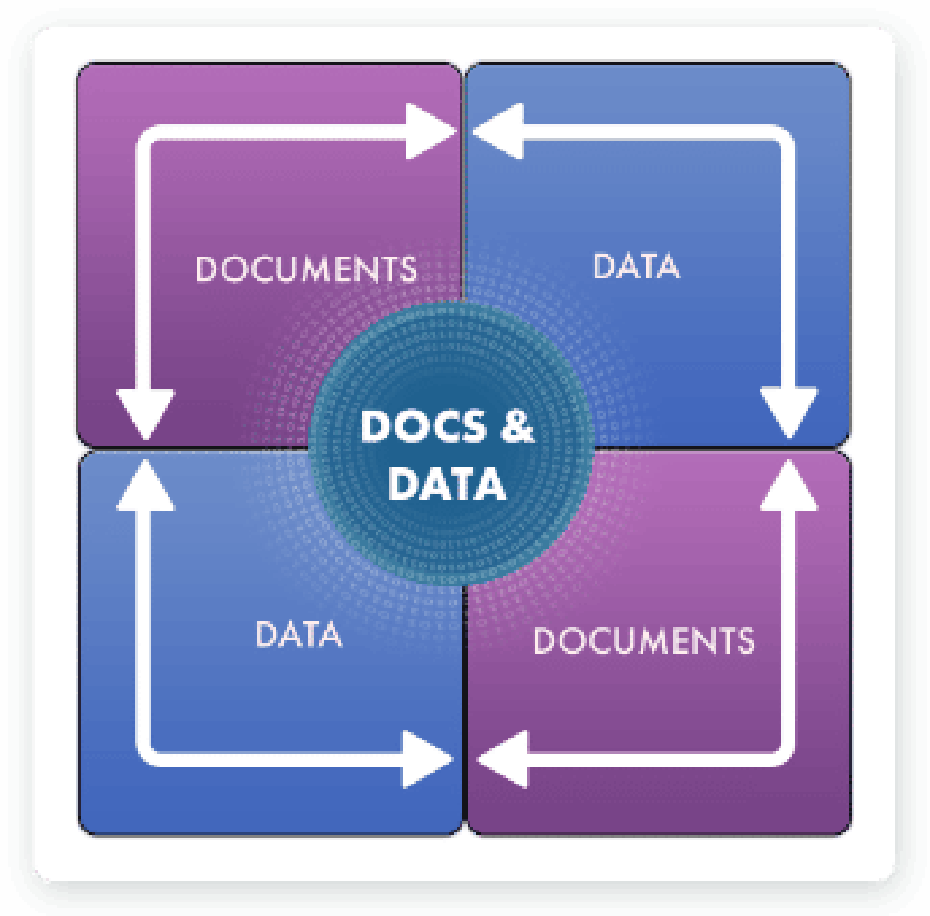
ECM In Action
At its core, our platform helps organizations capture, organize, manage, and automate their documents and business processes, all in one place.
Instead of juggling shared drives, paper files, and legacy systems, an ECM platform like VisualVault can bridge these diaparate sources of data and serve as a central hub.. Documents are no longer “lost” in folders or inboxes, they’re structured, searchable, and tied directly to workflows.
Here’s what that means in practice:
- Contracts automatically route for approval instead of sitting in inboxes
- Invoices are captured, processed, and stored without manual entry
- Employees can instantly find documents using search, not guesswork
- Teams collaborate in real time, regardless of location
- Compliance requirements are enforced automatically and audit prep becomes turnkey
The result? Smoother operations, fewer errors, and dramatically improved visibility across your organization.
Key Feature:
Find Any Document in Seconds Not Hours
Stop wasting time searching through folders or email threads. Advanced search and metadata tagging allow users to instantly locate documents using keywords, filters, or contextual data.
Automate Workflows That Used to Be Manual
Replace repetitive, manual processes with automated workflows. Route documents for approval, trigger notifications, and ensure every step happens consistently without human bottlenecks.
Access Your Content From Anywhere, Securely
With cloud-based access, your team can securely retrieve and manage documents from any device, whether they’re in the office, remote, or on-site.
Reduce Risk With Built-In Compliance Controls
Ensure documents are stored, accessed, and retained according to regulatory requirements. Audit trails, permissions, and version control help maintain full compliance.
Scale Without Adding Complexity
As your organization grows, your content management system grows with you. No need to rebuild processes or migrate systems—everything is designed for enterprise scalability.
ECM VS. TRADITIONAL DOCUMENT STORAGE
Traditional Document Storage
- Static file storage (shared drives, folders)
- Manual organization
- Limited search functionality
- No workflow automation
- High risk of duplication and errors
- Minimal security controls
Enterprise Content Management (ECM)
- Centralized, structured content system
- Intelligent search and metadata tagging
- Automated workflows and approvals
- Integrated with business systems
- Strong security and compliance features
- Full document lifecycle management
Bottom line: Traditional storage holds files. ECM transforms how your business operates.
Artificial Intelligence (AI) is a Transformative Tool
GRM leverages cutting-edge Artificial Intelligence (AI) to bring ever-greater efficiencies to document management processes. The below functional areas are where our clients are presently experiencing the most substantial benefits of AI.

Text Extraction
Intelligent extraction of data that completely eliminates the manual review and manual data entry that creates cost and errors.

Classification of Documents
Training AI models to classify documents and auto-assign key data like retention rules and security designations.

De-duplication
Employing AI to review documents, score the content, identify the location of duplicate content and auto-delete rather than relying on expensive and slow manual review.

Predictive Analytics
Using trends in volume and time-in-stage, predictive models forecast spikes, flag risk, and highlight bottlenecks so teams adjust resources before commitments slip.
Structuring and Putting Data to Work
Almost every business struggles with data and process-centric inefficiencies and errors and they often look to records management companies and document management companies to help but traditional companies and resources may fall short. What’s required is a platform, like VisualVault, GRM’s sister company, that’s capable of helping those businesses make huge strides forward in erasing those inefficiencies and errors by employing powerful digital tools. The building blocks of VisualVault solutions are the ability to consolidate data, organize and structure it via our intelligent forms (iforms) and put the data to work with our workflow automation and workflow management tools.
In addition to inefficiencies and errors, distinct silos of data are also a reality of modern business. But, in order to step into the future, the walls of those silos need to be broken down and all data needs to be accessed. Once all data is identified and made accessible, it then needs to be normalized and made usable, structuring it with our intelligent forms technology. And finally, that data needs to be put to work using our simple workflow automation tool to design processes and route data and documents to where they need to be and usher along the process of what needs to be done automatically.
Industries Served
This platform is designed for organizations that manage high volumes of sensitive or regulated content. Common industries include:
- Healthcare – Manage patient records, ensure HIPAA compliance, and streamline administrative workflows
- Finance & Banking – Securely handle financial documents, contracts, and regulatory reporting
- Government & Public Sector – Improve transparency, records management, and citizen services
- Legal – Organize case files, contracts, and legal documentation with full auditability
- Logistics & Transportation – Track documents across supply chains and operations
- Energy & Utilities – Maintain compliance documentation and operational records
Each industry benefits from tailored workflows, compliance controls, and integration capabilities.


Capabilities That Usher In Tomorrow
While the central data management tools of our platform deliver enormous strides forward in reducing errors and improvements in efficiency, there are a host of other capabilities that serve as a means of working toward true digital transformation. These are technologies like machine learning (ML) and artificial intelligence (AI) that help clients move beyond the structured boundaries of existing data, processes and analysis. These technologies effectively consume massive volumes of data and discern sophisticated learnings and naturally apply that incremental intelligence and prompt action around future processes. This is the purview of modern content services platforms.
Intelligent Forms

Intelligent Forms or iForms are a central part of our VisualVault content services platform. iForms serve as a means of collecting and structuring information. Essentially serving as very sophisticated online forms, they can be populated via direct data entry or can be the recipient of mass uploads or auto-imported information.
Regardless of type of information or mode of populating the information, the forms serve to structure the information so that it can be put to work. Whether being pushed into a workflow automation process or analyzed and presented via sophisticated analytics to deliver new and valuable insights, iforms are a central part of the platform.
Why Choose The Grm Content Services Platform?
Our content services platform was born and bred in the cloud. It’s open, agile and integrates quickly and seamlessly with your current technology infrastructure and solutions. Yet, it’s highly-secure, highly-scalable and delivers extraordinary processing power. Excelling in the most demanding and highly regulated environments such as Healthcare and Public Sector, the GRM platform is a tool without dead-ends… only path is forward.
For a closer look at a couple of Healthcare applications of our platform, check out this Healthcare Information Management blog post (HIM Automation) and the Healthcare Legacy Data Archive blog post (LDA).
Watch To Learn About Our Content Services Platform
GRM’s content services platform is a complete solution for managing content, designing workflows and deriving valuable business insight.
ECM vs. Traditional Document Storage
Traditional Document Storage
- Static file storage (shared drives, folders)
- Manual organization
- Limited search functionality
- No workflow automation
- High risk of duplication and errors
- Minimal security controls
Enterprise Content Management (ECM)
- Centralized, structured content system
- Intelligent search and metadata tagging
- Automated workflows and approvals
- Integrated with business systems
- Strong security and compliance features
- Full document lifecycle management
Bottom line: Traditional storage holds files. ECM transforms how your business operates.
Csp Vs Ecm
There is substantial overlap between both the definitions and functionality of an ECM platform versus a CSP – and very, simply, that’s why confusion and a lack of clarity exists. Ultimately, they are both technology solutions that exist to organize, manage and leverage data. We think the simplest way to differentiate the two is by characterizing a CSP as a more agile, more organic, more advanced ECM platform. By all accounts, a CSP is more future-oriented, cutting-edge technologies such as AI are more central to the offering and they are unencumbered by the constraints of existing repositories, unique governance and other legacy technology considerations.
What Is Enterprise Content Management (ECM)?
Enterprise Content Management is a technology solution that consolidates, organizes and allows for the usage and sharing of documents and data throughout their lifecycle. The centralized repository is the basis of the solution and exists to enable the management of existing documents and data.
What Is A Content Services Platform (CSP)?
A content services platform is a technology solution that delivers a set of tools that exist to deliver agile data-centric services and systems in a distributed environment. The services are a critical part of the offering and are focused on creating strategic processes and business insights.
While no image can thoroughly communicate the differences between the two, the below can help communicate some of the major differences at a glance:
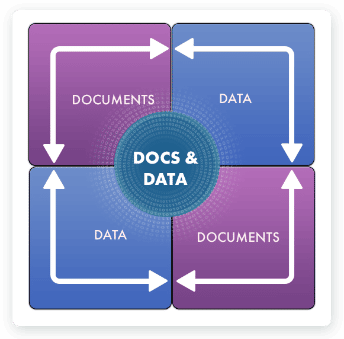
Enterprise Content Management Platform (ECM)
Structured documents and data in a single repository with processes designed to maximize efficiency
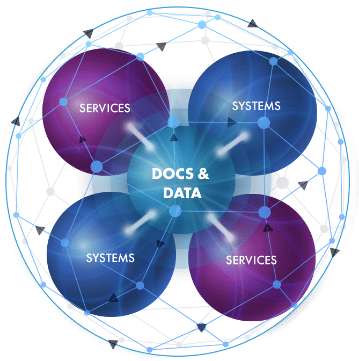
Content Services Platform (CSP)
Multiple content repositories, services and systems to drive digital transformation
FREQUENTLY ASKED QUESTIONS
What is enterprise content management (ECM)?
Enterprise content management (ECM) is a system that helps organizations capture, store, manage, and automate documents and content across their entire lifecycle. It improves efficiency, reduces risk, and enables better decision-making.
What’s the difference between ECM and document management systems (DMS)?
A document management system (DMS) focuses primarily on storing and organizing files. ECM goes further by adding workflow automation, integrations, compliance controls, and full lifecycle management.
Why move to a cloud-based ECM platform?
Cloud-based ECM provides greater flexibility, scalability, and accessibility. Teams can work from anywhere, systems are easier to maintain, and organizations can scale without infrastructure limitations.
How does ECM improve business workflows?
By automating document routing, approvals, and notifications, ECM eliminates manual steps, reduces delays, and ensures consistency across processes.
CONTACT SALES
To speak with our Sales team call 888.907.9687 or complete the form below.
For Customer Service inquiries contact Customer Support